
Major Legal & Financial Updates in Early 2026 You Should Know
(Washington’s 9.9% Tax Proposal, Green Card Priority Dates, EB-1/EB-2/EB-5 Trends & Child Protection Planning)
U.S. laws and policies are shifting in early 2026 across tax, immigration, and estate planning. From Washington’s proposed 9.9% income tax on high earners to green card priority date movement, employment-based filing trends, and child protection planning, recent developments may significantly affect individuals, families, and business owners.
Assumptions based on prior years may no longer apply. Proactive planning — not reactive decision-making — is increasingly critical.
This article explains the most important legal and financial updates in early 2026 in clear, straightforward language so you can understand what is changing and how to prepare.
Disclaimer: This article is for general educational purposes only. It is not legal advice. Immigration outcomes depend on individual facts and circumstances.

1) Washington Senate Approves 9.9% Tax on Income Over $1 Million — What High Earners Should Know
Last week, the Washington State Senate passed a bill proposing a 9.9% tax on personal income above $1 million per year.
The proposal is not yet law — it must still pass the House — but it represents a significant potential shift in Washington’s tax structure.

Key Points:
Applies to income over $1,000,000
The first $1M remains untaxed
Would take effect January 1, 2028 (if enacted)
Applies to individuals and married couples
Includes wages, bonuses, and pass-through business income
Example:
An individual earning $1.2M would pay 9.9% on $200,000
≈ $19,800 in additional taxBusiness owners should note: income from S-corps, LLCs, and partnerships would count toward the $1M threshold.
What to keep in mind:
This proposal is separate from Washington’s existing capital gains tax and would significantly broaden taxation of high-income households.
While legal and political challenges are likely, individuals earning near or above $1M should begin reviewing long-term planning strategies now — not in 2028.
Nexus Law advises high-income families and business owners on multi-year, tax-efficient planning strategies.
If this proposal affects you, proactive planning matters.
2) Is Your Green Card Priority Date Now “Current”? Don’t Miss Your Filing Window.
If your priority date recently became “current,” this may be your opportunity to move forward with your green card.
But visa bulletin movement can change quickly — and waiting too long can delay your case by months or even years.
This is not automatic. You must act.
What “Current” Means
Each month, the U.S. Department of State publishes the Visa Bulletin.

If your priority date is earlier than the date listed for your category and country, your date is considered current.
When that happens, you may be eligible to:
File Form I-485 (Adjustment of Status)
Complete consular processing abroad
Apply for work authorization (EAD)
Apply for travel authorization (advance parole)
Why Timing Matters
Visa bulletin dates can retrogress (move backward).
If you delay filing:
You could lose your window
Your child could face age-out risks
Your work authorization timeline could shift
Employment-based applicants — especially EB-2 and EB-3 from India and China — should monitor carefully.
What to keep in mind:
When your date becomes current, strategy matters.
If your date is current — or close — we recommend reviewing your case immediately to avoid missing your opportunity.
Learn more through our Instagram post: Link
3) EB-1A, EB-2 NIW, and EB-5: Why 2026 Is Seeing a Surge in Filings
We are seeing a clear rise in professionals and investors pursuing:
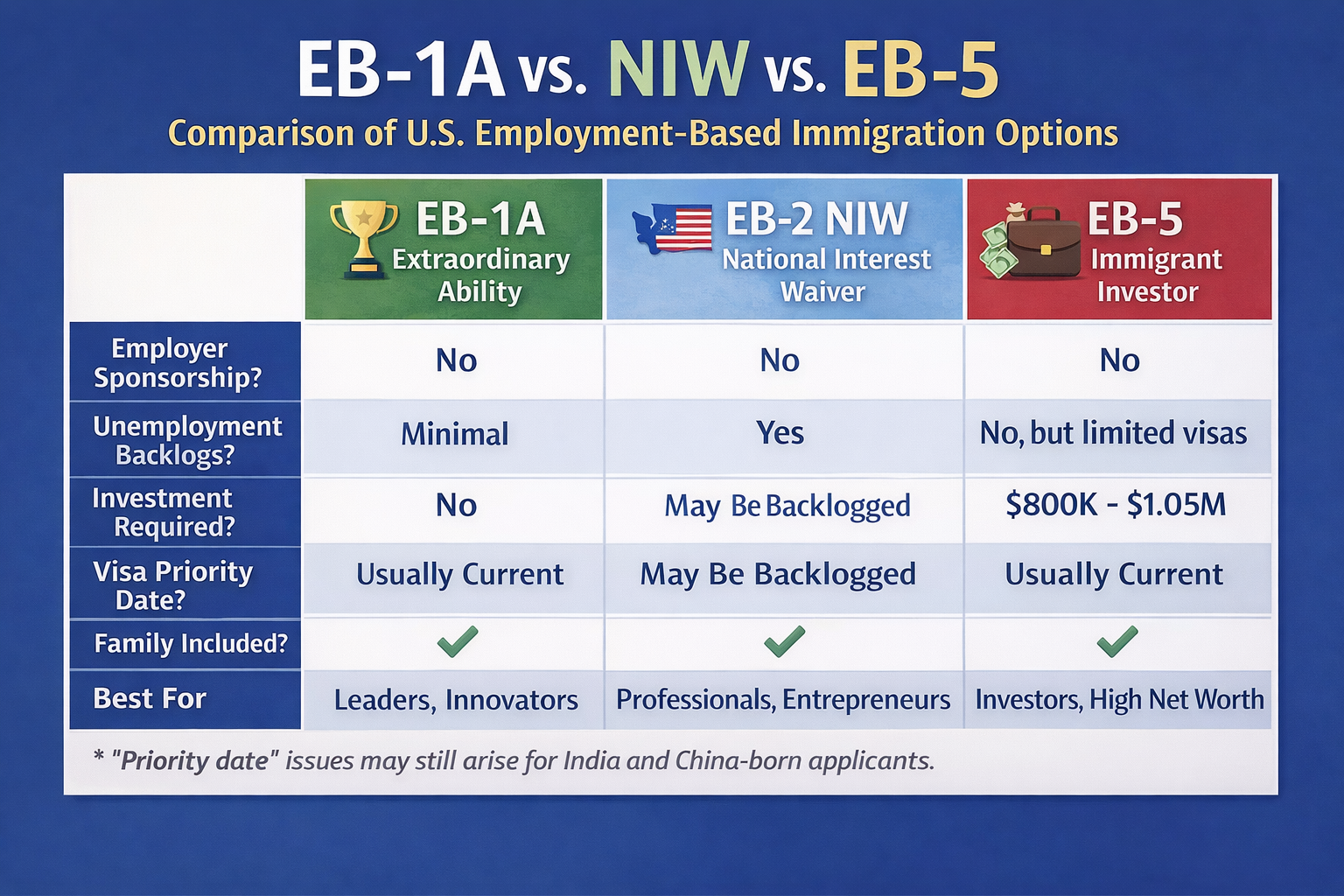
EB-1A (Extraordinary Ability)
EB-2 National Interest Waiver
EB-5 Immigrant Investor
This shift is strategic — not random.
Why the Increase?
Severe EB-2 / EB-3 backlogs
Layoff volatility in tech and healthcare
Growing awareness of self-petition options
Children aging out of eligibility
Desire for independence from employer sponsorship
More professionals are asking:
“Which category gives me the strongest long-term control?”
Why It Matters
These categories can offer:
No employer sponsorship (EB-1A / NIW)
Greater portability
Parallel strategy options
Protection against priority date uncertainty
However, standards are rising. Strong documentation and strategic positioning are critical.
What to keep in mind:
Immigration in 2026 is no longer just about qualification — it’s about positioning.
If you are evaluating alternatives to employer-sponsored pathways, a strategic case assessment can help determine your strongest category.
4) If Something Happened to You Tonight, Would Your Child Be Protected?
Many parents assume their child would automatically stay with family in an emergency.
Under Washington law, that is not always guaranteed.
If both parents are suddenly unavailable — due to accident, hospitalization, or unexpected events — and no guardianship documents are in place, delays and uncertainty can follow.

Without Proper Documentation:
Schools may refuse release
Medical decisions may be delayed
Relatives may lack authority
Court involvement becomes urgent
Temporary state placement becomes possible
Foster care is not automatic — but lack of planning increases risk.
What Parents Should Have:
Guardian nomination
Emergency caregiver authorization
Clear custody consent language
Trust planning for minor children
What to keep in mind:
These documents prevent legal gaps during a crisis.
Planning is not about fear — it is about control.
A short conversation today can prevent chaos tomorrow.
If you have minor children and no formal guardianship
5) 221(g) Notice? When the Embassy Keeps Your Passport, What Does It Really Mean?
Visa stamping continues to take longer for many applicants in 2026. This applies to work visas, student visas, and dependent visas.
Applicants commonly see:
Longer wait times for interviews
Administrative processing (often called 221(g))
Requests for additional documents
These delays are often caused by expanded security checks and closer review of application details.

What is 221(g)?
Section 221(g) means your case requires additional review before a final decision can be made.
This may involve:
Administrative processing
Additional background checks
A request for missing documents
Internal review by another government agency
It is not an approval — but it is not a denial either.
Why Did They Keep the Passport?
If the embassy kept your passport, it usually means:
The officer anticipates possible approval
They may issue the visa once processing is complete
However, timelines vary. Some cases resolve in days. Others take weeks or longer.
What Should You Do Next?
Carefully review any written instructions given at the interview
Submit requested documents promptly (if applicable)
Monitor your CEAC case status online
Avoid making irreversible travel plans
Do not assume silence means refusal.
What to keep in mind:
221(g) cases require patience — and sometimes strategy. Delayed isn’t equal to denied!
If your case remains pending or you are unsure how to respond, a review of your interview and documentation can help clarify next steps.
Learn more through our Instagram post: Link
Click here to schedule a consultation to discuss your case and potential strategies under current U.S. immigration rules.
This article is a service of Nexus Law, PLLC, an immigration and business law firm based in Bellevue, Washington. We help individuals, families, students, and employers navigate complex U.S. immigration rules and policy changes with clarity and confidence. If recent USCIS or DHS updates may affect your visa, green card, travel, or work authorization, we invite you to schedule a complimentary 15-minute consultation to discuss your options and next steps.
This content is provided for general educational and informational purposes only and does not constitute legal advice. Immigration laws and policies change frequently and are highly fact-specific. Reading this article does not create an attorney-client relationship. For legal advice tailored to your individual circumstances, consult a qualified immigration attorney.